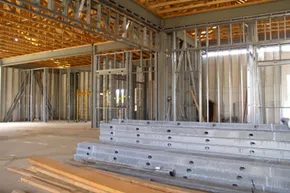
It started with a hype machine in 1928. Popular Science Monthly declared the “All-Steel House” was coming to take over America. Steel manufacturers toured cities, showing off frames that went up with terrifying speed. In Forest Hills, New York, crews assembled an entire modular skeleton in three hours and fifty minutes. The math worked too. Sure, steel cost more than lumber, but you saved so much on labor that the budget balanced out. It was a middle-class dream of modern, fast, and cheap housing.
Then the war hit.
World War II froze the industry. All that steel? Gone. Requisitioned for tanks, ships, and planes. Private homebuilding hit a wall. No materials. No builds.
When the war ended, the industry didn’t just restart—it found a new purpose. Architects saw past the hype and looked at the structural reality. Frank Lloyd Wright used steel to frame his famous Usonian houses in the 1940s. Some of those homes, like the Buehler House in Orinda, California, are now on the National Register of Historic Buildings. They proved steel wasn’t just for factories.
Today, steel framing is the default for commercial buildings. Residential use is climbing. Why? Because wood has flaws. Steel studs don’t bow. They don’t bend. They don’t shrink or warp as seasons change. They are impervious to termites. They resist mold. They are fire-resistant. And they are 100 percent recyclable. Jeff Lupton, an Atlanta-based contractor, notes that the price gap has closed. Building with steel studs is now more affordable than it was a decade ago.
So why isn’t every DIYer switching?
Зміст
Why Steel Studs Are Replacing Wood
You might think the switch is obvious. It’s not. It’s complicated.
First, look at the materials. Steel studs are thin. They look fragile compared to a chunky 2×4. But they are strong. They are consistent. You never have to wonder if a piece of wood has a hidden knot or a crack. You get the same profile every time.
Second, consider the tools. Wood framing uses hammers and nails. Steel framing uses screws and drills. You need a specific gauge of screw. You need a drill with torque control. If you overtighten, you strip the threads. If you undertighten, the wall is loose. It’s a different muscle memory.
Third, there’s the issue of insulation. Wood studs act as a thermal bridge. They let heat escape. Steel is a better conductor. It lets heat escape faster. You need to break that thermal bridge with foam boards or specialized insulation batts. If you don’t, your energy bill goes up. It’s not a dealbreaker, but it’s a step most wood framers skip.
The Hidden Costs of Switching to Steel
Affordability is relative. The material cost is competitive now. But the labor?
If you hire a pro, they might charge more. They aren’t used to it. They charge for the time it takes to learn. If you DIY, you are the learner. You will make mistakes. You will buy the wrong screw. You will measure twice and cut once—then realize you cut the wrong side.
Here’s
Television home renovation shows make drywall work look effortless. You see someone mount a massive TV or hang a heavy cabinet in seconds. They rarely show the struggle. They don’t show the trial and error. When you pick up a drill, you probably assume the wall behind the drywall is wood. That assumption is dangerous if your house was built with steel studs.
Steel framing changes the rules of the game.
Steel is dense. It resists drill bits. It creates friction. And it creates sparks.
The Spark Risk
Drilling through metal generates heat. Sparks fly. This is not just a messy problem. It is a fire hazard. Many contractors refuse to drill steel studs entirely if a lighter solution exists.
You can hang fairly lightweight items without touching the stud. Use anchors designed specifically for drywall. These bypass the steel entirely.
Winged plastic anchors are the cheapest option. They spread out behind the drywall. They are less likely to pull out than standard ribbed anchors.
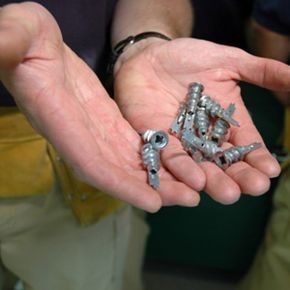
Threaded drywall anchors are stronger. They screw directly into the gypsum board. Some hold up to 50 pounds per anchor. This is enough for medium-weight shelves or artwork.
For larger projects, decorators use strap toggle anchors. These distribute weight across a wider area of drywall. They are rated to hold up to 80 pounds. This is useful for mirrors or small floating shelves.
The Drywall Limitation
Drywall is soft. It crumbles under pressure.
Front-heavy items put torque on the anchor. A towel bar pulls forward. A shelf sags under weight. Over time, the drywall expands. The anchor loosens. It fails.
If you need to hang something heavy, drywall anchors are not enough. You must engage the steel stud.
Drilling into Steel
You cannot use a standard wood drill bit. It will dull instantly. It will not cut.
Use titanium or cobalt drill bits. These alloys are hardened for metal. They cut cleanly. They resist heat.
Drill a pilot hole through the drywall and into the steel stud. Use a toggle bolt to secure heavy items. The bolt expands behind the stud or through a slot in the metal. It creates a secure mechanical lock.
This method works for televisions, heavy mirrors, or large shelving units.
The Wood Block Method
There is another way. It is more invasive. It is also more secure.
Cut a small section of drywall. Install small sections of wood between the steel studs. Screw the wood into the steel frame. Now you have a solid wood backing.
Attach your heavy items to this wood block. You can use standard wood screws. You get the holding power of wood with the structural integrity of steel framing.
This is best for very heavy loads. Kitchen cabinets. Large entertainment centers. Anything that weighs more than 80 pounds.
The Trade-off
Steel studs offer fire resistance. They do not rot. They are straight and true.
They are difficult to decorate.
You need the right tools. You need the right anchors. You need to accept that a simple nail will not work.
If you use titanium bits and toggle bolts, you can hang almost anything. If you cut and block, you can hang anything. The wall will hold.
Just watch for sparks. And maybe keep a fire extinguisher nearby. Just in case.