You just ran a cycle at 60°C. Maybe you even pushed it to 90°C. The clothes still smell musty. So you scrub the rubber door gasket. You clean the drain filter in the bottom right corner. You run an empty hot wash with white vinegar. The smell comes back within a week.
Here is what nobody tells you. The real culprit is likely hiding in plain sight: the drawer where you pour your detergent.
Most homeowners ignore this compartment until the odor becomes unbearable. They focus on visible surfaces like the drum or the seal. But the true source of contamination is the detergent drawer. It is an incubator for mold, bacteria, and residue that you revisit every single day without noticing.
Зміст
The Detergent Drawer: The Forgotten Contamination Source
The drawer is not just a storage bin. It is the primary breeding ground for mold in your washing machine. Not the drum. Not the seal. The small grey or white tray you pull out mechanically to add liquid or powder, then push back in without a second thought.
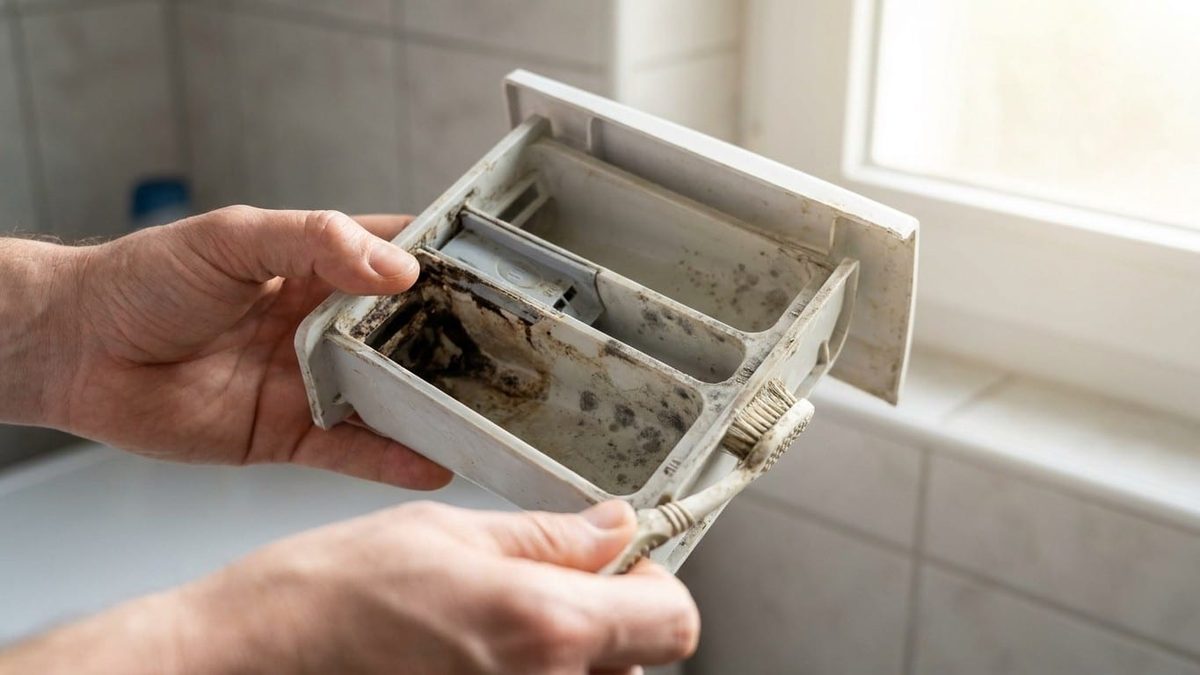
When mixed with moisture, leftover detergent and fabric softener create a perfect environment for mold growth. You might recognize it as a black, slimy film. This film is the source of those nasty odors.
This compartment accumulates residue, mold, and bacteria rapidly. Without regular cleaning, these deposits clog the internal channels. They alter washing quality. They leave a stale smell on your clothes. It is a vicious cycle. You pour fresh detergent into a receptacle colonized by microscopic fungi. That detergent lands on your clothes before the wash even begins.
Leaving the drawer closed after a load traps residual moisture. You do this because it looks neater. It prevents bumping into it. But you are creating exactly what mold loves: humidity. Darkness. Residual heat. It is a perfectly calibrated domestic incubator.
The Unlock Tab You Likely Have Never Pressed
Here is what a technician checks first when called for “smelly laundry.” The unlock tab on the drawer.
To remove the drawer completely, you must open it as far as it goes. Then, look for a button or latch. Press it to release the drawer. On some front-load models, you pull the drawer fully out and press a center button. On others, a slight side-to-side wiggle while pulling will disengage it.
Most people do not know the drawer can be removed entirely. They pull it to its limit. Wipe the top surface with a sponge. Put it back. In doing so, they clean about 30% of the problem. They ignore the rest.
Even if the drawer looks clean at first glance, get close and sniff. Mold hides in hard-to-reach places. The bottom of the compartment. Internal baffles. Product distribution holes. These areas ferment quietly for months. Years, sometimes.
Overdosing detergent in the drawer is a common mistake. We often overdo it, especially with liquid detergents. The cap is calibrated for maximum loads. Most of us never wash full loads. These residues stick. They accumulate. They form an ideal substrate for fungi. Excess detergent clogs your appliance. Stale smells develop. They eventually embed themselves in your fabric fibers.
The Protocol That Changes Everything in Under Ten Minutes
Remove the drawer completely. Press the unlock tab at the bottom of the compartment. Pull firmly. Often harder than you expect.
If the drawer is heavily soiled, soak it in warm water with a little dish soap for 30 minutes. Scrub every area thoroughly. Include the distribution channels.
For tougher deposits, try a one-hour soak in hot water with a tablespoon of baking soda. This helps loosen stubborn grime.
Your best tool? A used toothbrush. Not a sponge. Not a cloth. A toothbrush. The internal corners of the drawer are designed to direct product flow, not to be easy to clean. The toothbrush reaches those tight spots.
Pay special attention to the holes where detergent flows into the drum. These small openings are often the most obstructed. They are the least accessible to the naked eye.
Once the drawer is clean, do not neglect the cavity itself. The housing inside the machine. Clean the support area with a brush. Scrape small holes in the upper panel to remove limescale or mold traces. This is where rinse water passes to carry detergent to the drum. Limescale deposits here reduce flow. They leave residue with every wash.
Leave the drawer slightly ajar between cycles. This simple act promotes aeration. Applied systematically, it halves the rate of mold recolonization.
Following this cleaning method at least once a month prevents mold effectively. You can stop fighting the smell by addressing the source.
Why 60°C Fails Without Cleaning the Detergent Drawer
You raise the heat. It feels like the logical fix for smelly laundry. Low-temperature cycles often miss bacteria and mold lurking in the washer. These microbes survive. They thrive. The result is that pungent damp smell. But even at 60°C, if the contamination source remains intact inside the drawer, hot water just moves that gunk around. You aren’t sanitizing. You are rinsing dirty clothes with contaminated water.
Bacterial strains, including pathogens, colonize domestic washing machines. Mold settles into seals, detergent dispensers, and drum corners. Every wash gets tainted. The issue isn’t the temperature setting. It is the permanent infection hub. Cleaning the drum at 90°C while ignoring the dispenser is like disinfecting walls without fixing the leak.
Here is the part most people miss. A clogged drawer stops products from flowing. This is often why a washing machine doesn’t take detergent. It compromises wash quality and damages the appliance over time. A dirty dispenser does more than cause odors. It actively ruins every load by preventing detergent from dissolving or circulating. Your shirts smell musty because they were never truly clean.
“A dirty dispenser actively ruins every load by preventing detergent from dissolving or circulating.”
Check your dispenser regularly. Scrape out the gunk. Rinse it until water runs clear. It takes two minutes. Your clothes will thank you. The smell stays gone.