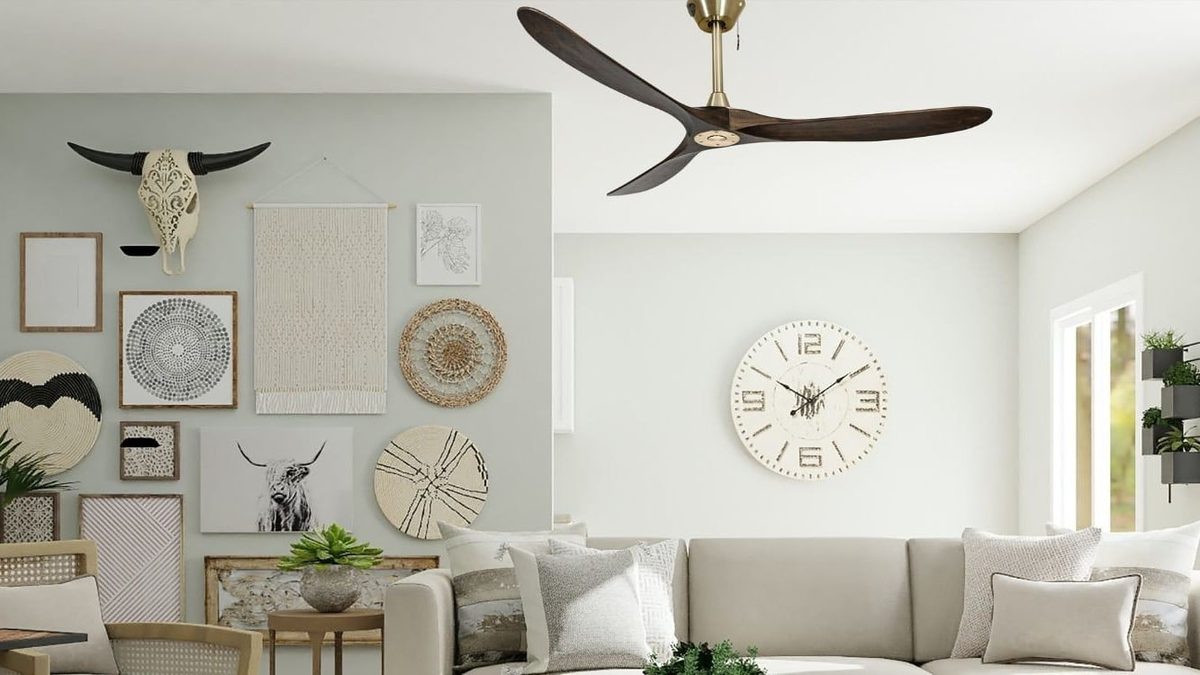
You are paying for electricity. The fan is spinning. But your living room is still sweltering in July.
This is the universal frustration of homeowners who don’t know where that tiny switch is. Most French households are heating their own homes in the middle of summer with perfectly functional ceiling fans. The culprit is a detail rarely mentioned in installation manuals. A small toggle that determines if you get a breeze or a convection oven effect.
It takes two minutes to fix. It changes your comfort completely. And it might lower your energy bill more than you think.
Зміст
What Your Ceiling Fan Actually Does to Room Air
First, let’s clear up a myth. A ceiling fan does not lower the actual temperature of the air in your room. Thermometers don’t move when you turn the fan on.
What it does is manipulate perception. It works through evaporation. Moving air speeds up the evaporation of sweat on your skin. This is the wind-chill effect. It’s the same reason you feel cooler standing in front of an open freezer door, even though the air temperature outside the freezer hasn’t changed.
In summer mode, the correct rotation pushes air straight down. This creates a direct breeze. The result? A perceived temperature drop of 3 to 5 degrees Celsius. That difference is the line between sleeping soundly and tossing and turning every twenty minutes.
But this only works if the air moves downward. If the blades are spinning the wrong way, the fan just churns the air. You get noise. You get movement. You still sweat.
Counter-Clockwise for Summer, Clockwise for Winter
Natural convection is your guide. Hot air rises. Cold air sinks. Your fan can either fight this or work with it. The direction of rotation decides which battle you’re fighting.
Summer: Counter-Clockwise
For cooling, the rule is absolute. Blades must rotate counter-clockwise.
When viewed from below, the blades move from right to left. This pulls air up and pushes it down, creating a downdraft. If you stand directly under the fan and feel a breeze, you are in summer mode. If you only feel movement when standing to the side, the direction is wrong.
Winter: Clockwise
In winter, the logic flips. Your heating system warms the air, which rises to the ceiling. This creates heat pockets near the roof while your feet stay cold.
By switching to clockwise rotation, the fan creates an updraft. It gently pushes the warm air pooled at the ceiling outward and down along the walls. It redistributes the heat without creating a draft on your skin.
A reversible fan can reduce heating bills by up to 30% in winter.
This is not just theory. It’s physics. You stop wasting energy heating empty ceiling space.
The Universal Test
Some brands say counter-clockwise is always summer. Others might differ. Don’t trust the label. Trust the air.
If the air moves down onto your head, it’s cooling. If the air moves up and around the room, it’s redistributing heat.
How to Reverse Blade Direction Without an Electrician
You don’t need to call a pro. You just need to know what kind of motor you have.
AC Motors: The Physical Switch
Most traditional fans use AC motors. They have a small plastic switch attached to the motor housing, usually near the top of the fan blades.
- Turn off the fan completely. Wait for blades to stop.
- Get a sturdy ladder.
- Locate the switch. It’s often a small lever or slider.
- Flip it.
This takes about two minutes. But it requires a ladder and stopping the fan mid-day. It’s annoying. That’s why so few people do it.
DC Motors: The Remote Control
Modern fans often use DC motors. These are smarter. They have a built-in reversal function.
Look at your remote. Do you see a button with two circular arrows? That’s it.
- Press the button.
- The fan will slow down.
- It will stop.
- It will restart in the opposite direction.
This is convenient. But there is a catch.
Never change the direction while the blades are spinning.
You will damage the motor. You might burn out the capacitor. Always wait for a complete stop.
The Speed Setting Matters
Reversing the blades is only half the equation. Speed controls the effect.
In summer, you want a breeze. Use medium to high speed. You want to feel it.
In winter, you want circulation. Use speed 1.
This is critical. If you use high speed in winter, you create a draft. You defeat the purpose. The goal is a gentle, invisible movement that pushes heat down the walls. If you feel wind on your skin in winter mode, you are too fast. Slow it down.
It’s a small adjustment. Invisible to the eye. But it changes everything. Or doesn’t. Depending on which way the blades are pointing.
The Thermostat Mistake You’re Making With Your Ceiling Fan
Most people run their ceiling fan and air conditioner at the same time but forget to adjust the thermostat. That is a missed opportunity. Running your ceiling fan in summer mode allows you to raise the AC thermostat by two to three degrees Celsius without losing comfort. Each extra degree saves roughly seven to ten percent on AC consumption.
There is one critical precaution few people apply: this only works if someone is in the room. Turn off the fan when you leave. It does not cool the air. It serves no purpose without occupants and consumes electricity for no reason. At low speed, a DC motor fan uses between three and eight watts. That is negligible compared to an air conditioner.
Yet leaving an empty appliance running for eight hours a day makes no sense. Even at that low consumption level.
In large rooms with cathedral ceilings or lofts with mezzanines, the impact is even more pronounced. In these volumes, the temperature difference between the floor and the ceiling can exceed eight degrees. A Parisian apartment with a standard twenty-five-meter ceiling is one thing. A living room open to the eaves is a different physical challenge. A properly oriented fan makes a measurable difference on your energy bill. Both summer and winter.
Sources: casafan.fr | ventilateurs-plafond.com