Most homeowners know this frustration. You want a perfectly straight reference line across a drywall surface or across a large room. Your eyes can deceive you. Your hand shakes. You try to use a ruler, but none of them were long enough. You end up with crooked lines that destroy the symmetry of your project.
You don’t need a massive aluminum straight edge to solve this problem. A chalk line is required.
This is an old fashioned tool. It is very cheap. Very effective. If you are planning a renovation project where alignment is important (installing wallpaper, installing tiles, building walls, etc.), this is the marking tool of choice.
Зміст
What is a chalk line?
People call it the chalk line. Some also call it a chalk reel. Some people use chalk boxes. it doesn’t matter. These are the same tools.
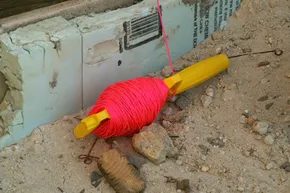
This device comes with a sturdy case. Usually made of plastic or metal. There are two things inside: chalk powder and a long rope. Rope lengths range from 18 to 50 feet. This length covers almost every wall in a normal home.
At the other end of the shell is a hook ring. You can also use that tip as a plumb bob to create a vertical line. There is a crank on the side. This allows you to return the rope to the box. A simple mechanism. No battery. There are no electronic devices. Just physics and chalk.
How to Snap a Line Correctly
Using this tool is more than just pulling strings. If done poorly, the lines can become thick, dirty or invisible. You need to do it right.
First prepare the chalk. Shake the shells lightly. The powder must be spread evenly in the container. If the chalk is clumped, the lines become broken or uneven.
Next, place the hook. Place it on the wall at the start marker. Drag the box down to the second mark. Do not let the rope touch the wall. You just measure the distance.
Now an important step. Place the rope at the second mark. Pull the thread tight. You want tension. If the thread is loose, the effect is bad.
Then pull the string away from the wall. Lift it straight up or down. Let it snap back to the surface.
This function is called snapping a line. Impact can cause chalk powder to adhere. You will see sharp, thin, perfect lines. It’s immediate. This is accurate.
Chalk lines are not just for marking. You can also use the case itself as a plumb bob. Extend the line to find a point directly below the hanging point.
Troubleshooting and maintenance
Chalk lines is durable, but not indestructible. The most common point of failure is the string itself. Pull it too hard when snapping. Using too much tension. The rope may break.
Beware of chalk powder. Moisture is your enemy. If the chalk gets wet. It becomes useless. Store the box in a dry place. If the powder gets dry or wet, you can buy a replacement boxes. They are available in white, red or blue. White is the standard for drywall. Red or blue may look better on dark surfaces or wood.
Essential Companion Tools
Chalk lines are strong. It is not a stand-alone solution for every task. You still need other tools in your toolbox.
You need a square for the corners. You need a level to checking verticality. You need a ruler to draw short lines. You will need a carpenter’s pencil to mark the rough lumber.
Combine these tools. Use the tape measure to find your points. Check the angle with a square. Use chalk lines to connect them.
Why do-it-yourselfers love this method
Simple tools are easy to overlook. We are interested in high-tech laser levels. They are precise